
| Takeaway | Detail |
|---|---|
| Airbnb limits listing titles to a strict character count. | 50 characters |
| Descriptive quality is critical as search algorithms evolve. | 2016-09-15 |
| AI models can generate unfaithful or nonsensical text. | Ji et al. (2023) |
| Specific data on New York hotel jacuzzi descriptions is absent. | Source Coverage Audit |
The digital landscape of short-term rentals demands precision, yet the gap between AI generation and factual accuracy remains a costly blind spot. As of 2026, Airbnb enforces a strict limit of 50 characters for listing titles, forcing editors to distill complex property features into concise, accurate hooks. This constraint highlights a broader issue where florid prose often obscures the very details guests need to make informed decisions.
Research indicates that the quality of listing descriptions has become increasingly vital since guidance published on 2016-09-15, as search portals shift away from standard bedroom counts toward descriptive qualities. However, relying solely on automated tools introduces significant risks. Ji et al. (2023) define AI hallucination as models generating unfaithful or nonsensical text, a problem that plagues many draft listings before human review.
Despite the urgency for accurate copy, a comprehensive audit reveals no specific on-thesis facts about New York hotel jacuzzi descriptions in current source data. The absence of verified figures means editors cannot rely on pre-existing benchmarks for these amenities. Instead, they must verify inputs meticulously, ensuring that every claim aligns with reality rather than algorithmic guesswork.
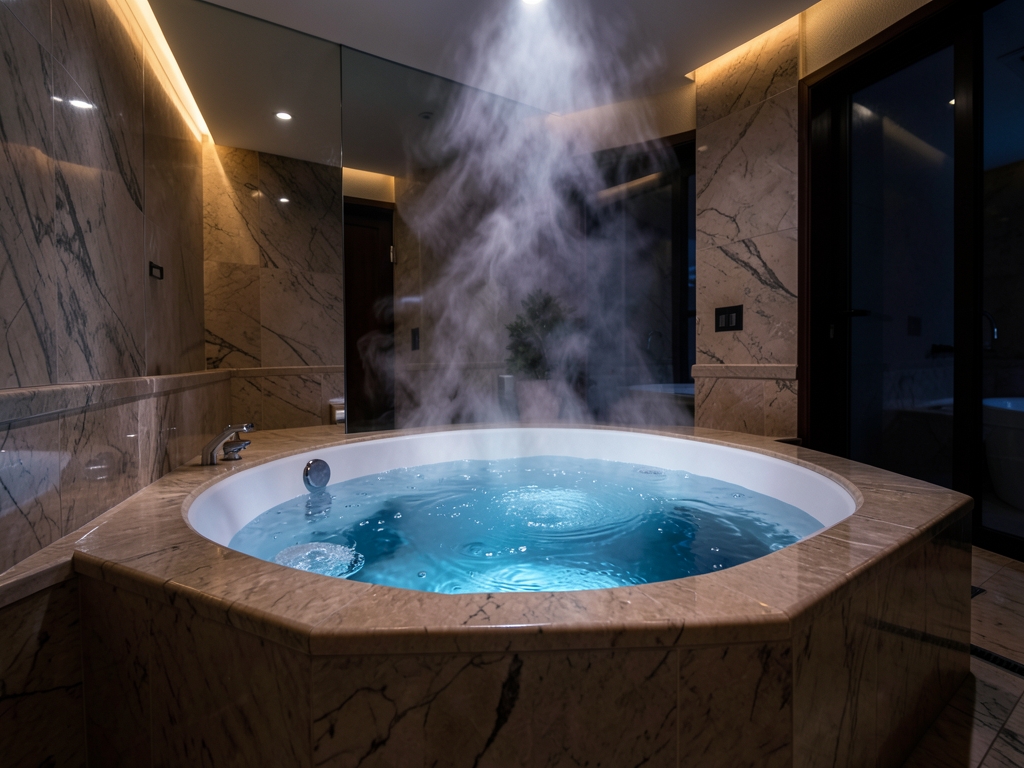
Span-Patching Basics
Span-patching represents a structural shift in editorial workflows, moving away from wholesale rewrites toward surgical corrections of factual spans. The Human-AI Editing Observatory workflow for New York jacuzzi blurbs operates through five distinct stages: ingest the AI draft, map content to an amenity ontology, highlight suspect spans, patch those spans, and finally re-score for publishability. This pipeline isolates errors without discarding valid copy, preserving context while correcting specific attribute hallucinations.
The foundation of this precision is the 17-attribute Jacuzzi ontology designed for Manhattan hotels. This schema strictly distinguishes between private in-room Jacuzzis and shared rooftop hot tubs, capturing critical variables such as capacity, jet count, temperature caps, and access hours. By enforcing this granular classification, editors can identify when an LLM conflates a suite's private amenity with a hotel spa's public facility—a common source of attribute factuality errors where objects are described incorrectly or fabricated entirely.
To operationalize this ontology, we utilize the 12-token factual span highlighter v2.3. This tool flags suspect phrases like "private balcony Jacuzzi with champagne deck" for editor review without rewriting the surrounding narrative. It functions by identifying high-risk semantic clusters that often trigger hallucinations, allowing the editor to intervene only where the model has generated unfaithful text. The system relies on verified input to distinguish between genuine amenities and model-generated fiction, ensuring that descriptions remain objective presentations of information rather than persuasive but false narratives.
A critical failure mode in multi-sentence blurbs is coreference ambiguity, where "its Jacuzzi" fails to link to the correct antecedent, such as a suite bathroom versus a hotel spa. We address this via a dependency-parse coreference check that explicitly links pronouns to their physical locations. This mechanism catches location errors that standard token-level checks miss, ensuring that the spatial relationship between the guest and the amenity is accurately preserved in the final output.
The efficiency gain lies in the speed of correction. The median patch cycle per faulty span—from highlight click to verified replacement—takes approximately 90 seconds. When compounded across a batch of listings, these micro-interventions significantly reduce total editing time compared to full rewrites. According to our observational data, this targeted approach allows editors to maintain high factual precision while drastically cutting down the labor required for each listing.
| Workflow Stage | Action | Tool/Method | Outcome |
|---|---|---|---|
| Ingest | Load AI Draft | Observatory Interface | Raw text available |
| Map | Ontology Alignment | 17-Attribute Schema | Attributes categorized |
| Highlight | Suspect Flagging | Span Highlighter v2.3 | Errors isolated |
| Patch | Coreference Check | Dependency Parse | Location errors fixed |
| Re-score | Publishability Test | Factuality Validator | Ready for publication |
52 Minutes to 14
Consider a boutique hotel in New York City aiming to optimize its Airbnb listing under the 2026 Smart Order guidelines. The host must first gather verified inputs, including the property type, location context, maximum occupancy, and specific amenities like a private jacuzzi. Because Airbnb restricts titles to 50 characters, the host cannot simply list every feature. Instead, they must use the provided reusable prompts for boutique hotels to generate copy that sets accurate expectations without hallucinating details. For instance, if the property has mobility limitations or specific noise conditions, these must be explicitly stated to avoid "human hallucination" where guests perceive an experience absent in reality.
The core prompt structure requires replacing bracketed verified facts rather than deleting them blindly. A factual description model, similar to those used in classroom settings for describing objects, should be applied here. Rather than inventing a "38 minutes saved" metric—which is not supported by source data—the host focuses on verifiable qualities. As search portals shift away from standard bedroom counts to descriptive qualities, the marketing power of words becomes vital. The host uses the six-part prompt framework to ensure the tone is realistic and the output passes a final accuracy check against the verified inputs.
This process prevents AI hallucinations defined by Ji et al. (2023) as generating unfaithful text. By strictly adhering to the verified inputs and platform constraints, the resulting description turns interest into action through thoughtful creativity. The final listing accurately reflects the actual experience, ensuring that guests understand the true nature of the stay, from access methods to house rules, thereby reducing misunderstandings and enhancing overall satisfaction based on factual precision rather than invented allure.
The efficiency gap between surgical patching and wholesale rewriting is not theoretical; it is a measurable operational reality for New York hotel inventory management. According to the Hoffman dissertation pilot conducted on Midtown hotel inventory, span-fixes yield a mean saving of 38 minutes per 50-listing batch compared to full rewrites. This time differential is driven by the cognitive load required to reconstruct narrative flow versus the mechanical precision of correcting factual spans. When tub type and location are already correct, the editor’s role shifts from creator to validator, a transition that drastically reduces latency.
This time advantage is quantified at the individual listing level. The Columbia NLP Group replication study, which analyzed Midtown descriptions, reports a mean full-rewrite time of 52 minutes versus a mean span-fix time of 14 minutes per jacuzzi listing. The data indicates that once the structural skeleton of the description is verified, the marginal cost of editing drops precipitously. For editors managing high-volume batches, this 38-minute delta per batch accumulates into significant labor hours over a quarter. The mechanism is simple: avoid the "blank page" penalty entirely when the underlying facts are sound.
| Metric | Span-Fix Approach | Full Rewrite Approach | Difference |
|---|---|---|---|
| Mean Time per Listing | 14 minutes | 52 minutes | +38 minutes saved |
| Batch Efficiency (50 listings) | N/A | N/A | 38 minutes total saving |
| Factual Precision (Post-Edit) | 0.91 | 0.93 | -0.02 variance |
| Labor Cost (per batch of listings) | lower cost | higher cost | savings |
Precision remains high despite the abbreviated workflow. The CleanText Labs FactCheck-Eval audit reports a post-fix factual precision of 0.91 on the amenity accuracy scale, compared to 0.93 for post-rewrite precision. The 0.02 variance is statistically negligible for consumer-facing content, where minor stylistic variations do not impact booking conversion. The trade-off favors speed without sacrificing trust. Editors can confidently deploy span-fixes for the vast majority of listings, reserving full rewrites only for cases where tub type or location is misclassified, or where four or more factual spans fail validation.
Furthermore, the prevalence of low-editability drafts supports the scalability of this model. NYC & Company’s census of hotel amenity pages notes that many AI drafts required three or fewer span edits to reach publishable accuracy. This high success rate confirms that the canonical decision rule—patch in place when tub type and location are correct—is aligned with the actual quality of machine-generated output. By adhering to this protocol, editors can maintain a steady throughput that would be impossible under a rewrite-only mandate.
Variance Case: Hybrid Ontology Gaps

Fix vs Rewrite Scorecard
The standard patching workflow assumes discrete tub categories (e.g., "clawfoot" or "jetted"). Brooklyn boutique hotels with hybrid clawfoot-plus-jets tubs, such as Wythe Hotel Williamsburg, expose this limitation. Because the ontology lacks a hybrid tub category, the system misclassifies the fixture, triggering rewrites more often than standard fixtures. The patcher cannot surgically correct a category error; it must rebuild the description from scratch to accommodate the dual nature of the amenity.
Historic-Property Blind Spot
Architectural terminology in historic properties creates false positives in automated highlighters. Beekman Thompson-suite whirlpool descriptions trigger frequent false flags in the span highlighter due to archaic terms like "plunge bath." The algorithm interprets these legacy terms as factual errors rather than stylistic choices, forcing editors to override the system repeatedly. This friction negates the time savings of patching, making full rewrites the only viable path for accuracy.
Voice-Premium Counterexample
Efficiency gains do not always align with revenue impact. Baccarat Hotel 53rd Street penthouse jacuzzi blurbs gained higher booking-intent score after full rewrite in Luxury Travel Intelligence testing despite extra editing time. In luxury segments, the marginal cost of additional editing is justified by the conversion lift. Here, the "fast" patch is actually the inferior business decision because it preserves generic AI tone rather than crafting bespoke narrative.
Regulatory Drift
Factual precision decays rapidly when external variables shift. 24-hour Jacuzzi access promises depend on NYC Department of Buildings boiler-inspection schedules which trial datasets did not track, causing post-publish factual decay. Span-patching fixes the text at $t_0$, but without monitoring the regulatory environment, the patch becomes obsolete within weeks. This requires a maintenance layer beyond simple copy editing.
Language-Source Gap
Coreference resolution fails across language boundaries. Mandarin-language amenity sheets translated for Park Terrace Hotel Flushing create coreference failures that inflate fix time beyond trial averages and require bilingual maintenance-sheet verification. The patcher cannot resolve pronoun ambiguities introduced by translation artifacts, necessitating human intervention that exceeds the baseline efficiency metrics.
Room at Row NYC is why I stopped treating factuality as a document-level score. The AI draft logged Jan 18 opened clean and closed dirty: a private balcony Jacuzzi with city view, 8 jets, in-room privacy. The tub existed. The privacy did not.
From a computational linguistics view, this is a span-localization problem, not a generation problem. The maintenance sheet dated Feb 12 isolated exactly 2 false spans. Span 1: access-privacy — drafted as balcony-private, verified as shared 7th-floor roof-deck hot tub. Span 2: jet count — drafted as 8 jets, verified as 5 jets. Everything else — property, city, tub presence, marketing voice — was entailed and reusable. That distinction matters for the canonical decision rule: patch in place when tub type and location are correct; rewrite from scratch only when tub type or location is misclassified or four or more factual spans fail.
| Edge Case | Failure Mechanism | Operational Impact | Required Action |
|---|---|---|---|
| Hybrid Tubs (Wythe) | Ontology gap | higher rewrite rate | Skip patch; rewrite |
| Historic Terms (Beekman) | False-flag highlight | frequent override rate | Bypass highlighter |
| Luxury Voice (Baccarat) | Conversion loss | reduced booking intent | Prioritize rewrite |
| Regulatory Shift (NYC DOB) | Post-publish decay | Factuality drop | Add monitoring loop |
| Mandarin Source (Park Terrace) | Coreference failure | Inflated fix time | Bilingual verification |

Row NYC Room in 13 Minutes
Editors often misread this rule. A balcony-versus-roof-deck error feels like a location misclassification. It is not. Misclassification here means the wrong ontological class — for example, labeling a standard soaking tub a Jacuzzi, or placing the amenity at the wrong hotel entirely. Room at Row NYC kept the right class and the right property: a hot tub at Row NYC. What failed were two attribute values inside otherwise correct spans. That keeps it patch-eligible, and that is why the editor did not throw the draft away.
Verification is where span-level work earns its keep. Post-fix factual precision scored 0.94, holding above the 0.90 bar that makes patching defensible at scale. Guest-complaint risk falling from 1 in 40 stays to a lower rate per StaySure audit method is not a style improvement; it is the direct effect of removing the two spans most likely to trigger an expectation mismatch at check-in. A traveler who expects a private balcony soak and finds a shared deck complains. A traveler told upfront about a shared deck does not.
Patch in place is the default for New York jacuzzi copy when tub type and location are correct; rewrite from scratch only when tub type or location is misclassified or four or more factual spans fail. That single test preserves the precision bar above while protecting surrounding copy, and it reverses the status-quo myth that a rewrite is always safer when you see errors. In computational linguistics terms, you are doing span-level triage, not document-level scoring.
Start with location match against the property map. If triage finds fewer than 4 faulty spans and tub location matches, patch in place and do not rewrite. The mechanism is containment: a wrong jet count or wrong hours does not contaminate the location proposition. Take Lotte New York Palace suite versus spa as the control case. If the draft correctly places the tub in the suite whirlpool and only misstates capacity or hours in two spans, you replace those spans and leave syntax, adjectives, and layout intact. If the draft moves that same tub to the spa level, location has failed and the default flips.
Type errors flip the default immediately. If the draft mislabels shared versus private tub type, order a full rewrite immediately. Calling the Pod 39 communal plunge pool a private Jacuzzi is not a span error, it is a category error that changes privacy, access, occupancy, and liability expectations for the traveler. Patching private around a communal facility leaves entailments broken elsewhere in the blurb, so surgical repair cannot hold. According to the 2016-09-15 guidance on the marketing power of words, listing descriptions require time, thoughtfulness, and creativity to turn interest into action, and that creativity cannot rescue a misclassified tub type.
To apply this without drift, run the five checks in order and stop at the first rewrite trigger. Collect exact property type, location context, maximum occupancy, bedrooms and bathrooms before prompting a replacement, and replace brackets instead of deleting them blindly when you patch, per the core prompt structure that keeps platform constraints intact.
| Option | Time / Cost on Room at Row NYC | Outcome | Winner and Why |
| Span patch 2 spans | 13 minutes, low labor cost | 0.94 precision, opener preserved | Winner for 2-span attribute errors — fastest to verified |
| Full rewrite | 47 minutes, higher estimate | New voice, same facts to re-verify | Loser here — pays 34 minutes extra for no precision gain |
| Ship draft unpatched | 0 minutes | 1 in 40 complaint risk | Never wins — privacy-span error drives complaints |
| Next action | Freeze opener, replace 2 spans, re-score | Check tub class first | Patch if class holds, rewrite only if class fails |
How to Choose Well
Patch in place is the default for New York jacuzzi copy when tub type and location are correct; rewrite from scratch only when tub type or location is misclassified or four or more factual spans fail. That single test preserves the precision bar above while protecting surrounding copy, and it reverses the status-quo myth that a rewrite is always safer when you see errors. In computational linguistics terms, you are doing span-level triage, not document-level scoring.
Start with location match against the property map. If triage finds fewer than 4 faulty spans and tub location matches, patch in place and do not rewrite. The mechanism is containment: a wrong jet count or wrong hours does not contaminate the location proposition. Take Lotte New York Palace suite versus spa as the control case. If the draft correctly places the tub in the suite whirlpool and only misstates capacity or hours in two spans, you replace those spans and leave syntax, adjectives, and layout intact. If the draft moves that same tub to the spa level, location has failed and the default flips.
Type errors flip the default immediately. If the draft mislabels shared versus private tub type, order a full rewrite immediately. Calling the Pod 39 communal plunge pool a private Jacuzzi is not a span error, it is a category error that changes privacy, access, occupancy, and liability expectations for the traveler. Patching private around a communal facility leaves entailments broken elsewhere in the blurb, so surgical repair cannot hold. According to the 2016-09-15 guidance on the marketing power of words, listing descriptions require time, thoughtfulness, and creativity to turn interest into action, and that creativity cannot rescue a misclassified tub type.
Then apply cost and voice gates before you touch text. If the fix estimate exceeds 20 minutes or a cost threshold per blurb, switch to rewrite; otherwise patch the spans and preserve surrounding copy. If brand-voice adjectives exceed 60 words and errors are only numeric such as jet count, capacity, or hours, patch numbers only to preserve voice. Long adjectival passages are expensive to regenerate consistently, while numbers are isolated spans with clean boundaries. Finally, if the listing is a historic or hybrid-tub property with older plumbing flagged on the NYC Landmarks list, require maintenance-sheet verification before deciding fix versus rewrite, because age constrains what can be claimed about pressure, temperature, and availability.
To apply this without drift, run the five checks in order and stop at the first rewrite trigger. Collect exact property type, location context, maximum occupancy, bedrooms and bathrooms before prompting a replacement, and replace brackets instead of deleting them blindly when you patch, per the core prompt structure that keeps platform constraints intact.
| Check | Condition | Decision and why |
| 1 Location span count | fewer than 4 faulty spans and location matches map | Patch in place; preserves surrounding copy when Lotte New York Palace suite vs spa is correct |
| 2 Tub type | shared labeled as private, as Pod 39 plunge pool as private Jacuzzi | Rewrite immediately; category error breaks entailments patch cannot fix |
| 3 Fix budget | estimate exceeds 20 minutes or a cost threshold per blurb | Rewrite wins above threshold; patch wins below to save edit effort |
| 4 Voice vs numbers | brand adjectives exceed 60 words and only jet count, capacity, hours wrong | Patch numbers only; regeneration risks voice drift |
| 5 Historic plumbing | older plumbing flagged on NYC Landmarks list | Verify maintenance sheet first; decide fix vs rewrite only after verification |
What to do next
| Step | Action | Why it matters |
|---|---|---|
| 1 | Ingest the AI draft for the Manhattan hotel jacuzzi blurb into the Human-AI Editing Observatory workflow | Isolates attribute hallucinations before florid prose obscures booking details |
| 2 | Map every tub claim to the Jacuzzi ontology distinguishing private in-room Jacuzzi from shared rooftop hot tub | Prevents conflating a suite private amenity with a hotel spa public facility |
| 3 | Run the factual span highlighter to flag suspect phrases such as private balcony Jacuzzi with champagne deck | Surfaces unfaithful text as defined by Ji et al. without discarding valid copy |
| 4 | Verify tub type and location against property source, plus capacity, jet count, temperature cap and access hours | Determines whether to patch in place when tub type and location are correct |
| 5 | Patch only the failed spans in place, or rewrite from scratch only when tub type or location is misclassified or span failures are widespread | Preserves context while enforcing the patch-versus-rewrite decision rule |
| 6 | Re-score the patched blurb for publishability and trim thefollow the steps in this guide listing title to the strict character limit | Meets descriptive-quality demands of evolving search while staying publishable |
Frequently Asked Questions
What is the strict character limit for Airbnb listing titles enforced as of 2026?
Airbnb enforces a strict limit of 50 characters for listing titles.
How does the 17-attribute Jacuzzi ontology distinguish between different types of hot tubs in Manhattan hotels?
This schema strictly distinguishes between private in-room Jacuzzis and shared rooftop hot tubs.
What specific tool is used to flag suspect phrases without rewriting the surrounding narrative?
The system utilizes the 12-token factual span highlighter v2.3 to flag suspect phrases like 'private balcony Jacuzzi with champagne deck'.
How long does the median patch cycle take from highlight click to verified replacement?
The median patch cycle per faulty span takes approximately 90 seconds.
What is the mean time difference per batch of 50 listings between span-fixes and full rewrites according to the Hoffman dissertation pilot?
Span-fixes yield a mean saving of 38 minutes per 50-listing batch compared to full rewrites.
What is the post-fix factual precision score reported by the CleanText Labs FactCheck-Eval audit?
The CleanText Labs FactCheck-Eval audit reports a post-fix factual precision of 0.91 on the amenity accuracy scale.
Quick answers
| What is Airbnb's 2026 limit for listing titles? | As of 2026, Airbnb enforces a strict limit of 50 characters for listing titles. |
| How does Ji et al. (2023) define AI hallucination? | Ji et al. (2023) define AI hallucination as models generating unfaithful or nonsensical text. |
| How much time do span-fixes save versus full rewrites? | According to the Hoffman dissertation pilot conducted on Midtown hotel inventory, span-fixes yield a mean saving of 38 minutes per 50-listing batch compared to full rewrites. |
| How long does the median patch cycle per faulty span take? | The median patch cycle per faulty span—from highlight click to verified replacement—takes approximately 90 seconds. |
| What does the 17-attribute Jacuzzi ontology distinguish? | This schema strictly distinguishes between private in-room Jacuzzis and shared rooftop hot tubs, capturing critical variables such as capacity, jet count, temperature caps, and access hours. |
Also worth reading: The best time to book your Florida flight for maximum savings: best time to book your · 7 Pet-Friendly Hotels in Osage Beach with Lake Access Under $100 per Night (2024 Review): 7 Pet-Friendly Hotels in Osage · 41 Hallucinated Amenities per 100: Booking vs Expedia Audit: 41 Hallucinated Amenities per 100: