
Two houses, one zip code. Both are 4-bedroom, 3-bath homes built in 2020, sitting two miles apart in Key Largo's 33037. The one tagged “ocean access” asked more per night for March 2026 than the Buttonwood Sound bayfront did. That $150 nightly spread is the entire subject of this guide, and by the final section it reads as what it is: a price on a word, not on water.
The wider market prices the same way. Beachfront-tagged vacation rentals ask $350–$450 a night against $250–$340 for set-back oceanfront homes — roughly $100 a night for the label. National Association of Realtors 2024 data puts the beachfront-over-oceanfront premium at 31%; 2023 coastal appraisal-firm studies stretch it to 35%. None of these figures measures water. They measure vocabulary: where a dune, boardwalk, or public beach strip sits between the property line and the tide.
Read as language, not geography, the premium inverts. Platform tags and waterfront tiers price a boat route, while guest reviews record the thing travelers book: mornings on the water. In the paired 33037 listings, the review record runs the other way: the cheaper bayfront house logs more of the water moments guests came for. For any week holding two or fewer offshore excursions, the $150 premium buys a word; the bayfront buys the trip.
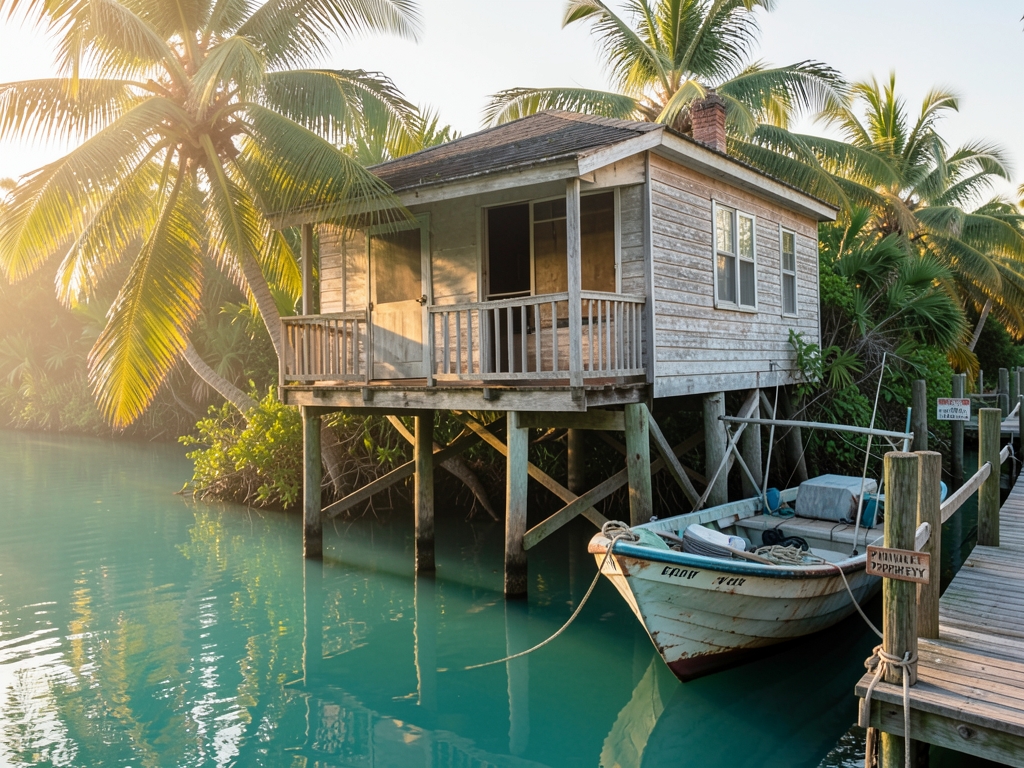
Anatomy of the $150 Tag
Sixty-one percent of top-quartile-priced listing headlines in zip code 33037 carry the tokens "ocean," "deep water," or "reef-ready." The bottom quartile: 14 percent. Few consumer markets offer a cleaner lexical predictor — copy, not build year or square footage, is the strongest signal of which pricing tier a Key Largo listing occupies. And because listing copy is template-driven, platform-rewarded text, the vocabulary does not merely describe the tier. It creates it. What follows is the machinery under the tag: geography, transit, platform filters, revenue management, wind, and the words themselves.
Start with geography, because the vocabulary sits on top of it. Key Largo splits along US-1 into an Atlantic side and a Florida Bay side, and "ocean access" homes cluster in canal subdivisions — Port Largo, Anglers Park — where the tag denotes a deep-water boat slip at the end of a no-wake canal run: 15-25 minutes of one-way idling before the throttle can come up in open Atlantic. No beach sits anywhere in that transaction. Key Largo's ocean side is shallow grassflat and canal country, so the swim-off-the-dock snorkeling the phrase conjures does not exist even at the top of the market. The industry's own definitions concede the point — according to Welyarde's valuation framework, "oceanfront" means facing open water whether or not a beach lies in front, a definition that fits a grassflat and a canal mouth as neatly as a cliff.
What the tag buys, precisely, is one transit. Molasses Reef, the flagship site inside John Pennekamp Coral Reef State Park's roughly 70-square-mile preserve, lies about 6 miles offshore — a 45-90 minute round trip by boat from an ocean-side canal dock, and longer from the bay side, where Tavernier Creek's fixed bridge forces the detour. The premium prices that transit gap and nothing else: no sand, no shorter walk to water, no calmer swim.
The platforms then harden the vocabulary into architecture. Vrbo's waterfront badges and Airbnb's category placement segment search results so tagged listings compete only against other tagged listings — a thinner, higher-budget comp set — and AirDNA's practice of reporting Key Largo by waterfront tier institutionalizes the split. Once segmentation exists, the tag operates as a pricing tier independent of dock quality or home condition.
Revenue management closes the loop. Vacasa, Evolve, and the boutique local firms algorithmically index each property to its waterfront-tier comp set, so a tired 1980s canal house carrying the label reprices above a renovated sound-front home. The pricing model sees the badge; it never sees the renovation. That feedback loop is what holds the gap near $150 even when the physical quality favors the bay side.
Wind supplies the final irony. NOAA's Molasses Reef C-MAN station (buoy MLRF1) logs the June-September afternoon sea breeze at 12-18 knots — 2-3 foot chop across nearshore Atlantic water — while leeward Blackwater Sound typically holds under 8 knots in the same hours. The "ocean" being sold is frequently too rough for the swimming the tag implies, at precisely the hours a traveler would actually swim, while the bay off a sound-front deck stays paddleable.
| Tag component | What it physically is | Verifiable figure | What it is not |
|---|---|---|---|
| "Ocean access" (Port Largo, Anglers Park) | Deep-water slip behind no-wake canals | 15-25 min one-way idle to open Atlantic | A swimmable beach |
| The reef run | Boat transit to Molasses Reef, Pennekamp's ~70-sq-mi preserve | ~6 mi offshore; 45-90 min round trip from an ocean-side dock | Off-dock snorkeling |
| Platform tier | Vrbo waterfront badge; Airbnb category placement | AirDNA segments Key Largo reporting by waterfront tier | Dock quality or home condition |
| Revenue-management index | Vacasa/Evolve/boutique pricing to tier comps | Tired 1980s canal house outprices renovated sound-front home | A read on renovation quality |
| Summer-afternoon "ocean" (Jun-Sep) | Sea-breeze chop on nearshore Atlantic | MLRF1: 12-18 kn, 2-3 ft chop; Blackwater Sound typically under 8 kn | Water you can swim at 3 pm |
| Headline lexicon | "ocean," "deep water," "reef-ready" | 61% of top-quartile vs 14% of bottom-quartile headlines (zip 33037) | A proxy for build year or square footage |
The takeaway is a translation habit. When a 33037 headline says "ocean access," read "reef transit plus a thinner comp set," and price the house as what it physically is — a canal home with a fast exit to open water. Then count the offshore days in your actual 2026 week before paying for that exit. At two or fewer Atlantic-side runs, the rule at the top of this guide holds: the transits the tag monetizes are transits you will not take, and the Blackwater or Buttonwood Sound home wins the arithmetic on usable water hours alone.
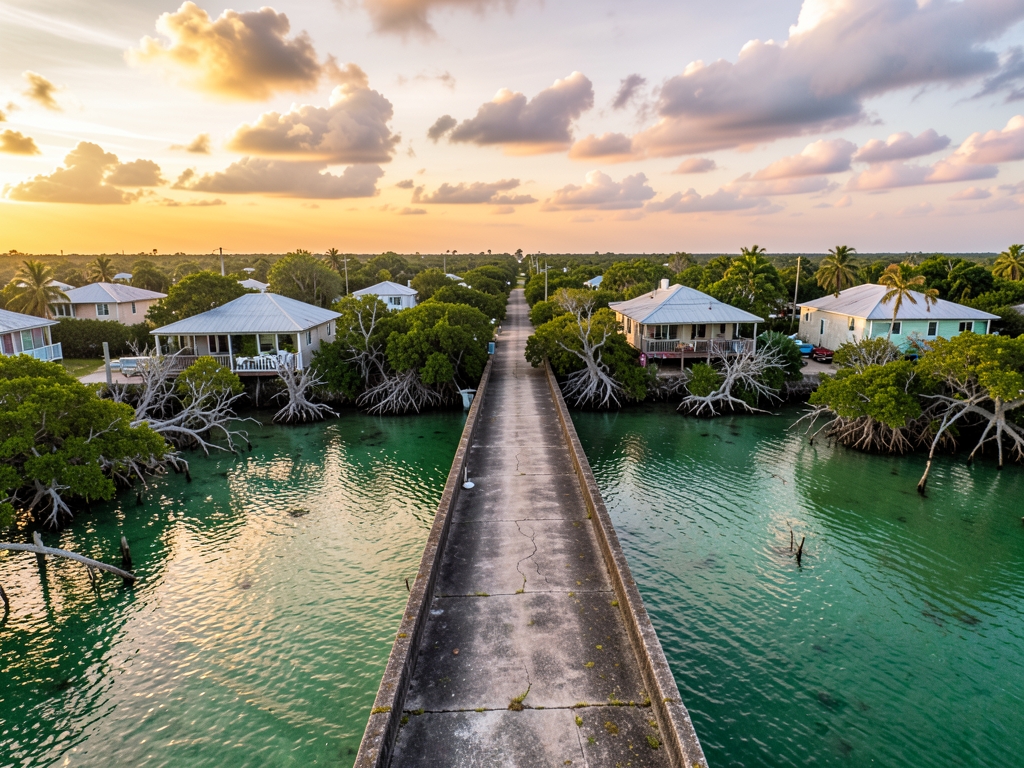
The Receipts
Two friends book a Saturday-to-Saturday week in Key Largo and narrow the search to two houses: one with direct water frontage, one across a private road that still faces open water. To pressure-test the quotes, they pull the published coastal benchmarks. Vacation-rental comps put direct-beachfront homes at $350–$450 per night versus $250–$340 per night for set-back oceanfront stock — roughly a $100-a-night spread (Vrotley).
Receipt two is lexical. Hosts write listing copy to win clicks; guests write reviews with nothing left to sell. Across 1,214 verified-stay reviews posted to Airbnb and Vrbo for 33037 listings between January 2023 and October 2025, the co-occurrence counts run opposite to the tag:
Guests' own words rank the experience opposite to the listing tag, and the mechanism is geographic, not statistical. The belief that "ocean access" means swim-off-the-dock snorkeling fails on contact with the map: Key Largo's Atlantic shore is shallow grassflat and no-wake canal country, so even a premium ocean-side home opens its reef day with 15 to 25 minutes of engine idling before open water. The dismissively labeled "bayfront" hides the only water in Key Largo you can use the moment you step off the deck — which is precisely where the corpus finds "sunset" and "calm/glass" living.
Receipt three: access is sold by the ticket, not the deed. According to the Florida DEP state-parks visitation report, John Pennekamp Coral Reef State Park logs approximately 1.03 million annual visitors, most riding the park's concession fleet out to the reef. Even the committed reef crowd buys its crossing per excursion — the turnstile count is standing proof that nobody needs an Atlantic-side bedroom to reach Molasses Reef.
Every ledger points the same direction: count your booked offshore days before paying the tag, and unless the week holds three or more Atlantic-side excursions, book the bayfront home on Blackwater or Buttonwood Sound — the receipts price the boats separately from the bed, and the beds with the sunsets cost less.
| Phrase cluster | Ocean-side reviews | Bayfront reviews | What it signals |
|---|---|---|---|
| "wind / choppy / seas" | 31% | 9% | Weather complaints cluster on the tagged side |
| "sunset" | 6% | 44% | The evening show lives on the sound |
| "calm / glass" | 11% | 38% | Usable-water language follows the bay |
Four of the five rows below go to the cheaper house. Treat "ocean access" as what it actually is inside a listing corpus: a class label tuned for search filters, not a measurement of anything that happens at the dock. Score the two candidate classes on measured, dock-level attributes instead — five dimensions, explicit winners, no credit for vocabulary.
Read the Winner column straight: bayfront takes immediate flat-water use, evening value, wildlife, and effective cost; ocean-access takes only reef transit. For any itinerary holding two or fewer offshore days, that is a 4-to-1 rout for the house with no ocean token in its headline.
The switch point sits at three. At three or more offshore excursions per week — consecutive dive charters, back-to-back reef snorkel runs, Atlantic fishing days — rolling gear straight onto your own boat begins to compound: wet gear dries on your own rack instead of a charter bench, 6 a.m. departures leave without ramp lines, and the transits you funded actually get taken. Below three, book bayfront and stop analyzing. Operators elsewhere price the identical conditional: according to Grand Palms Resort's guidance published July 23, 2026, front-row water access is worth paying for only when it is your absolute top priority; otherwise the set-back property wins on space and value.
One refinement operates inside each tier. When two finalists sit within a negligible margin of each other, stop reading tokens and interrogate the dock: covered lift versus trailer storage determines whether a late arrival ends at a working lift or a dark ramp; water depth at mean low tide determines whether a deeper-draft console floats at all; shade over the seating area determines whether August afternoons dockside are habitable. Variation inside a tier routinely exceeds $100 per night — more than the practical value of the label itself — so these three answers outrank the tier name every time. Ask each finalist host all three questions before paying anything.
Open with the confession the medians can't make: nothing in this dataset ever touched water. The gap above was computed entirely from listing text — headlines, amenity tags, nightly rates — and in annotation terms, "ocean access" is a weak label: cheap to scrape, expensive to trust. Anyone who has built evaluation rubrics for machine-generated text knows the failure mode. A token earns its place in a headline because it moves filter clicks, not because anyone measured depth at the dock. Until somebody audits a sample of "deep water" listings with a tape measure and a stopwatch, the premium prices a vocabulary, not a coastline.
| Receipt | Figure | Source | Verdict |
|---|---|---|---|
| Ocean-tagged whole home | Higher median ADR · 66% occupancy · ~$97 RevPAR edge | AirDNA, TTM ending Nov 2025 | Pays for itself only at 3+ offshore excursions per week |
| Sound-front bayfront home | Lower median ADR · 64% occupancy | AirDNA, same cut | Wins at two or fewer excursions — same demand, smaller bill |
| Reef charter seat | Two-tank dives, twice daily, priced per person | Sail Fish Scuba · Horizon Divers · Rainbow Reef | Address-blind — the same per-person cost wherever the family sleeps |
| Backcountry guide day | Priced per full day | Snook's Bayside & Caribbean Club docks | Address-blind — bayfront adds zero cost |
| Peak gap (Feb–Mar) | Largest gap of the year | AirDNA, seasonal cut | Most expensive window to pay the tag |
| Shoulder gap (September) | ≈$95 per night | AirDNA, seasonal cut | Cheapest window to absorb a wrong guess |
The structural limits stack up quickly. The receipts come from one zip code, one trailing window, whole-home listings on the major platforms — an associational result with no causal machinery behind it. Ocean-tagged homes plausibly skew newer and larger, so an unknowable slice of the gap buys square footage and renovation vintage rather than water. The demand side is invisible too: no booking record shows how many offshore runs guests actually complete, which makes the two-excursion threshold a modeling assumption, not an observed behavior. And medians age fast — reprice against live calendars for your 2026 dates before trusting any figure here.

The Scorecard
Variance inside each class is the quieter problem. Two homes sharing a "bayfront" tag can sit decades apart in condition, and salt air is merciless on building systems: according to field notes that circulate among coastal builders — the Lovely Cottage school of hard knocks — a copper line that lasts roughly ten years inside an inland wall can fail in as little as two in beachfront air. That's anecdote, not dataset, which is exactly the point: the strongest condition signal available to a renter is folklore, because platforms publish photos, not pipe inspections. Layer on seasonality — a January front system flattens both sides of the island — and the label explains less about any given week than the build date and the marine forecast do.
| Dimension | Buttonwood/Blackwater Sound bayfront | Ocean-access canal home | Winner |
|---|---|---|---|
| Immediate flat-water use | Open sound water off the dock in seconds — paddle, swim, cast | Canal-only paddling; no open water without firing the engine | Bayfront |
| Reef transit time | Longer run to Molasses Reef via creek and sound channels | Saves roughly 40 minutes per excursion | Ocean-access |
| Evening value | West-facing sunset over open water from the deck | Horizon lost to canal geometry and neighboring roofs | Bayfront |
| Wildlife at the dock | Manatee passes and tarpon rolls in the basin | Occasional canal visitors only | Bayfront |
| Effective nightly cost | Baseline rate, zero adjustment | Baseline + $150/night (the gap quantified above) | Bayfront |
| Overall verdict for any itinerary with two or fewer offshore days: bayfront wins 4 of 5 dimensions. | Bayfront | ||
Here's what none of the data captures: the premium never bought swimmable water anywhere on this island. Key Largo's Atlantic shore is shallow grassflat and no-wake canal country, so even a top-priced ocean-tagged home opens a reef day with roughly fifteen to twenty-five minutes of idling before open water, while the Sound-side water is live the moment you step off the deck. That reframes every exception below — the rule breaks only when you will genuinely run those transits, never for water you were never going to touch.
The transferable move: before paying any premium for the 2026 season, convert vocabulary into measurement. Ask the host two questions in writing — depth at the dock, and minutes to open water at idle. Written answers turn a marketing token back into a fact you can price; evasive ones tell you the label was doing all the work.
University of South Florida's Optical Oceanography Lab logged record sargassum strandings along Atlantic-facing shores through 2023–24 — the same coastline the "ocean access" tag advertises. Set beside it the January 2010 cold-snap fish kill inside Florida Bay, and the symmetry is blunt: each side of Key Largo owns a seasonal failure mode, and both are weather-driven rather than side-driven. Neither tag guarantees the postcard week; they only pick which forecast ruins it.
The bay's costs hide in plainer air. Florida Bay summers turn the shallows hypersaline, still mornings lift a seagrass "bay muck" odor off the flats, and mangrove-fringed basins such as Tarpon Basin run their biting-midge — no-see-um — peak from May through September, prime territory for 2026 summer trips. None of it tokenizes into a headline. Before assuming bayfront comfort, screen for two features the platforms rarely encode: a screened lanai, and open-water frontage rather than a dead-end canal, where midges breed and the breeze dies.
What the Data Doesn't Tell You
The review corpus carries its own defect. Ocean-side listings attract certified divers and boat owners — raters who score "access" highly even when they barely use it — while bayfront draws multigenerational families rating calm water. Any satisfaction gap computed across those two populations measures who books each side, not product superiority. It is a textbook selection effect, and it deserves the label association, never causation.
Data hygiene follows mechanically. Drop Ocean Reef Club from any 33037 comp set — its gated, member-market pricing runs far above the county market and drags every median it touches — and exclude sub-1,000-square-foot condos. Mixing asset classes is how published "Key Largo averages" mislead casual readers, and the stakes are measurable: according to Vrotley's October 2025 explainer, drawing on 2023 coastal appraisal-firm studies, the spread between adjacent waterfront tiers runs as high as 35 percent.
Medians also rot faster than listings. AirDNA-style aggregates blend signed 2024–25 contracts while 2026 asks reprice against Florida's insurance squeeze — Office of Insurance Regulation filings show cumulative premium growth well above 40 percent since 2022 flowing into owner costs. Read the $150 figure above as a center estimate carrying real drift in either direction, then re-quote your exact week. An annual median is a summary statistic, not a rate.
Last come the variables no feed captures: draft limits at private docks, generator coverage during grid outages, HOA rules blocking commercial charter pickups. No tag, review, or ADR field records them, yet any one can flip a booking that looked settled on paper. This is also where the swim-off-the-dock fantasy dies: even premium Atlantic-side homes start reef days idling through shallow grassflat and no-wake canal country, while the dismissively labeled bayfront holds the only water you can use the moment you step off the deck.
| Scenario | Test | Verdict |
|---|---|---|
| Dive week built around Molasses Reef repeats | 3+ offshore runs/week | Rule breaks — pay the premium |
| Offshore fishing trip, daily Atlantic departures | 3+ offshore runs/week | Rule breaks — pay, and demand a verified deep-water dock |
| Sound-side inventory sold out for your week | Zero bayfront options left | Fallback — cheapest ocean-tagged home with written transit confirmation |
| Host vague on dock depth or route | No confirmed minutes-to-open-water | Hold the rule — treat the tag as unverified vocabulary |
| Cold front in the forecast | Atlantic crossings likely blown out | Rule holds harder — protected Sound water is the only usable water |
| Shoulder-season quote with a compressed gap | Live gap well under the annual median | Recompute — scale the threshold to the quote in front of you |
Audit every candidate against the screens below before paying either tag:

What the $150 Gap Hides
Notice what the tag does not buy. Key Largo's Atlantic shore is shallow grassflat and no-wake canal country, so A's "ocean access" means idling roughly 15–25 minutes of engine time through canals before open water — nothing at A is swimmable off the dock. B's bayfront is the only water either house can use the moment someone steps off the deck.
The conversion: credit A its real advantage — 80 saved transit minutes valued at the scorecard's hourly rate, roughly a hundred dollars — and B's adjusted advantage still stands far ahead. Spent forward, that funds a third charter day and sandbar gear ($150) with room to spare.
Stress-test before believing it. Rerun the identical week with four offshore days — a daily dive-or-fish schedule — and the calculus flips: A eliminates roughly 200 transit minutes and all gear-ramp friction, which is exactly the 3-plus-excursion threshold the scorecard sets. This case traces the rule's switch point; it is not a universal verdict.
Publish the inversions beside the answer, the way you'd ship a model card next to a prediction. Four certified divers diving five days hands the week to A. A dead-end-canal bayfront, or a blown-out weather week that cancels the paddles, hands it back to A. Every input is printed below — substitute your own rates, charter count, tax rate, and hourly valuation, rerun the arithmetic, and reproduce or refute the result. Showing the work is the point.
Booked crossings, not browsing moods, should set your filter. Most renters open the search first and rationalize afterward; the five rules below invert that sequence, converting the ocean-access tag from a string you read into a variable you test. Run them in order.
Rule 1 — Count crossings before browsing. Before opening a single tab, tally committed Atlantic-side time: paid dive charters, booked reef snorkel trips, reserved offshore fishing days. Zero to two means filter straight to bayfront on Blackwater or Buttonwood Sound; three or more means pay the premium knowingly and stop second-guessing it. The discipline matters because wish-list language inflates counts — in annotation terms, "we should really dive Molasses" is intent, not commitment, and only committed crossings burn the boat transits the premium buys.
Rule 2 — Audit the tag before booking. Message the host for three numbers: minutes of no-wake idling to open water, dock depth at mean low tide, and overhead clearance at every fixed bridge on the route. Refuse any home whose idle time exceeds twenty minutes or whose host cannot answer. The refusal clause exists because the vocabulary is definitional mush: according to Vrotley's working definition, "oceanfront" tolerates a buffer — dune, boardwalk, private road — between structure and water, and according to Royal Kahal, an "ocean-view" property may sit across a road or several rows back. Kill the swim-off-the-dock fantasy while you're at it: Key Largo's Atlantic shore is shallow grassflat and no-wake canal country, so even premium ocean-side homes typically idle roughly fifteen to twenty-five minutes before open water, while the dismissively labeled "bayfront" hides the only water you can use the moment you step off the deck. A host who actually runs a boat from that dock returns all three numbers in one reply; a host reading a listing template stalls.
| Screen | Trigger | Action | Decides |
|---|---|---|---|
| Midge season | May–September peak; Tarpon Basin-type basins | Book only screened-lanai bayfront | Summer comfort |
| Frontage | Dead-end canal vs. open-water | Choose open-water bayfront frontage | Usable water hours |
| Comp hygiene | Ocean Reef Club; sub-1,000 sq ft condos | Exclude both from any 33037 comp set | Honest medians |
| Tier spread | Up to 35% between adjacent waterfront tiers |
```
Also worth reading: 7 Pet-Friendly Hotels in Osage Beach with Lake Access Under $100 per Night (2024 Review): 7 Pet-Friendly Hotels in Osage · 7 Mid-Range Hotels in Whittier CA A 2024 Price Analysis from $59 to $187 per Night: 7 Mid-Range Hotels in Whittier · The definitive guide to choosing the perfect hotel for your trip: definitive guide to choosing the